


Planning For Your Programmatic Advertising
Marketers may believe that programmatic advertising is quick and easy to set up and run. The reality is that the best campaigns win with strategic planning, quality creative development, and purposeful execution early on.
Programmatic advertising is the automated buying and selling of digital ad inventory through real-time auctions between demand-side platforms (DSPs) and supply-side platforms (SSPs). Target audience data is powered by platforms to determine which impressions are worth bidding on across many publishers. According to the Magna Global Programmatic Intelligence report and SearchLab, nearly 73% of digital ad spend across the globe is now bought programmatically.
Media buyers can optimize bids, budgets, creative, and audiences after campaign launch. What they can’t do is fix incomplete tracking. And rushed creative that doesn’t match audience intent, missed seasonal demand, or missed inventory opportunities can also hurt campaigns if not strategically approached.
While AI optimization has accelerated campaign adjustments, it still requires planning, quality data, and a complete campaign setup. Automation may improve execution, but it doesn’t replace the need for a strong strategy or good preparation.

How to Plan for Programmatic Advertising Success
No matter the type or number of channels incorporated into an advertising campaign, success starts with a clear media brief. The more information marketers can share with their creative and media buying teams, the better.
Media briefs should include, but not be limited to, defined goals, KPIs, preferred target audiences, and success metrics used for tracking specific campaign performance. Ensuring every decision maker needed is on board ahead of time avoids mid-campaign changes and post-campaign confusion.
Whether campaigns are set up with automated bidding, predictive optimization, or AI-assisted modeling, a comprehensive brief leads to highly effective programmatic media planning recommendations and decisions developed for your campaign.
A targeted audience strategy drives results. The ideal scenario incorporates your first-party data as a foundation layered with third-party data and contextual targeting. Define your priority segments, rather than a broad audience group. As AI becomes more integrated into advertising, the quality of your first-party data becomes even more important. Quality data produces better audience modeling, stronger optimization, and more relevant advertising.
Once your audience is defined, you can determine how and where to reach them.
Channel and Inventory Strategy
Your media team needs all the information shared above to determine the role each channel plays in your ad strategy, whether focusing on awareness, consideration, or conversion stages. They will align programmatic display, video, audio, CTV, and/or native channels to your campaign goals and plan for reach and frequency, not just impressions.
Advertising campaign planning also includes choosing the right ad platforms and partners based on your industry, audience, budget, and goals, and ensuring that low-quality inventory and MFA sites are avoided, prioritizing brand safety.
Budget Allocation and Flighting
Your audience, KPIs, and budget will help your media planning and buying team determine how to map budget spend to timing, seasonality, and campaign phases.
You should expect your team to track results during the campaign and adjust spend based on mid-campaign outcomes, possibly moving budget from one creative option or channel to another for greater outcomes and efficiencies.
Rushed Planning Scenario:
A healthcare system advertiser needed to launch a campaign quickly to promote a new service line. Last-minute planning led to an incomplete media brief. The campaign had to rely on broad audience targeting rather than customized and segmented audiences, unclear channel roles across CTV, video, and display, and an unclear budget.
Rushed tactics may deliver high impressions but low engagement and frequency, with some viewers seeing the ads too often and others not at all. CTV will drive reach, but not a clear path to conversion.
When execution isn’t rushed, audience segments can be more refined; each channel has clear, assigned roles, and the ad budget is allocated more strategically.

How Creative Planning Matters in Programmatic Advertising
When creative development is an afterthought and sent late or without all formats, it delays campaign execution, which can limit performance from the start. Not starting your campaign run with all the correct formats misses the opportunity to reach your audience in a relevant timeframe. Building in enough time for ideation and ad creation and ensuring messaging aligns with audience segments and funnel stages should be a priority.
Receiving creative files late or managing last-minute changes to ads delays campaign launches and forces rushed execution.
Multiple creative variations with different imagery and messaging allow media buyers to optimize mid-campaign, testing, and learning throughout. Those options also give AI-assisted optimization and Dynamic Creative Optimization (DCO) more opportunities to identify which messaging, imagery, and formats resonate with audiences.
When omnichannel campaigns are purposefully planned, many different types, formats, and sizes are needed to ensure creative matches placement across a variety of channels like display, video, CTV, and audio. Missing formats may also limit inventory access.
In the end, even the best creative won’t perform well if it’s not in hand when the campaign is scheduled to start.

The Importance of Meeting Advertising Deadlines
Strategic media planning defines what needs to happen, while deadlines ensure it happens on time.
Seasonal campaigns may require even more precise planning to ensure deadlines are met so that you are running during the required promotional timeframe.
An expert digital media buying team builds in time for QA before launch. When delays happen, something has to give. If the start date isn’t set in stone, the campaign launch will be pushed out until all other required setup steps are completed. If the launch date is required due to a promotional season, then QA may be rushed, which can lead to wasted spend.
In programmatic campaign management, timing is not just operational; it directly impacts performance and revenue.
Seasonal Campaign Scenario:
A retail brand planned a seasonal campaign tied to a key sales window.
- Creative was delivered late
- Tracking pixel validation was delayed, which affected the initial launch date
- The campaign was launched in phases instead of the preferred start date
Delays led to rushed QAs and the campaign missing an early high-impact shopping period, resulting in incomplete data during the first critical days of the campaign and unreliable signals that delayed campaign optimization.
While the results were positive, they were not optimal. Media managers make strategic changes over the lifetime of the campaign, but the initial campaign setup serves as the foundation for a positive outcome. Moving forward, the client was able to restructure campaign timelines, and creative deadlines were given more time, which allowed pre-launch QAs to be optimized.
How Optimization Works in Programmatic Advertising
Your media buyer will monitor campaigns and adjust as needed through budget reallocation, frequency management, and bid adjustments. They may also determine whether new creatives should be introduced or existing ones removed to focus on more successful options.
Audience targeting may also be refined based on campaign signals. Media buyers will make sure budgets are pacing correctly and identify underperforming placements early on.
Campaign optimization should be the norm, but the outcomes of those improvements are affected by the foundation of the initial campaign setup.
While ad platforms use more machine learning and AI to make recommendations or automate bidding, pacing, and audience optimization, experienced media buyers still keep their hands on the keyboard, interpreting recommendations, applying business context, and making the right final decisions that shouldn’t be left to automation alone.
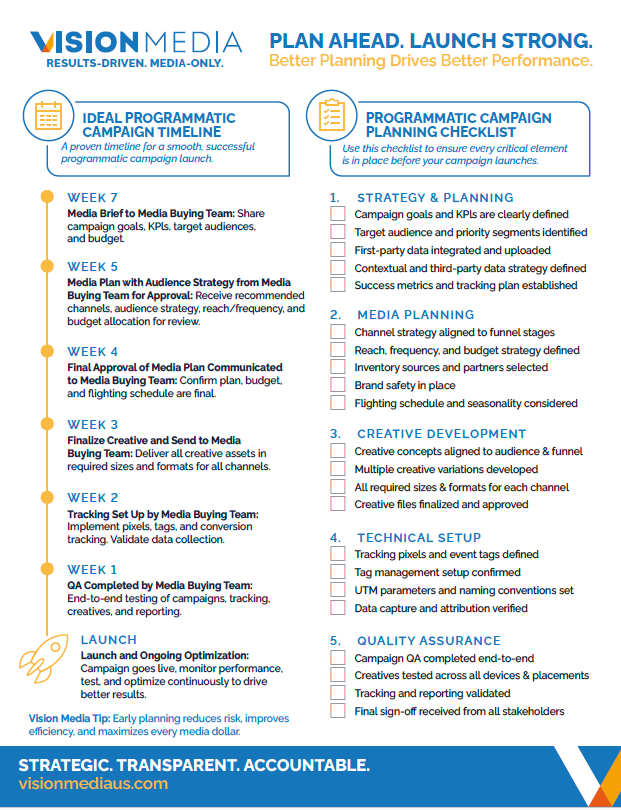
Download Programmatic Ad Planning Tool
4 Keys to Programmatic Advertising Preparation
Programmatic advertising preparation outperforms reaction.
- Programmatic advertising offers flexibility and efficiency across budgets, inventory, and placement types, but only when built on a strong foundation.
- Planning, creative, and timing are not separate; they are interconnected drivers of success.
- Platform audiences and inventory can be inspired by strategic planning insights.
- Planning ahead and meeting deadlines offer fewer surprises and more control over outcomes.
Advertisers with the best results will be those whose teams use intelligent technology partnered with thoughtful planning, high-quality creative, and the right media strategy.
As in our article about planning and timing for linear media buying, it’s not just about being on time; it's also about being prepared. Early planning allows your brand the advantage of choice, flexibility, and stronger performance. The best campaigns aren’t won after launch; they’re won in the preparation that leads up to it.


